Why Standalone AI Vision Cameras Fail Without Real-Time ERP Integration
Across modern precision fabrication, pharmaceutical bottling, and automotive component plants, manufacturing executives eagerly deploy high-resolution cameras powered by cutting-edge convolutional neural networks. The vision station detects a microscopic hairline crack on an assembly line, flashing a red beacon or sounding a local buzzer. Yet here, the digital trail hits a wall: the operator fails to catch the piece, the warehouse receives no quarantine alert, and the financial system books the defective asset at full production cost.
True Smart Manufacturing (Industry 4.0) is not achieved by merely identifying defects visually. It demands Closed-Loop Operational Automation: transmitting inference telemetry in under 30 milliseconds to deterministic sorting hardware (PLCs), while concurrently orchestrating enterprise actions—automatically updating work order scrap lines, rerouting batches into quarantine bins, and scheduling preventive maintenance work orders.
Blueprint Architecture Index:
The Human Inspection Dilemma & The 1-10-100 Cost Law
For decades, manufacturing quality assurance relied on manual visual inspection by operators stationed along high-speed conveyors. Empirical industrial engineering research reveals that human optical acuity drops sharply after 20 to 30 minutes of continuous focus due to ocular fatigue and repetitive sensory saturation, permitting between 12% and 20% of micro-defects to slip downstream unchecked.
The 1-10-100 Rule of Quality Cost Escalation
This manufacturing economic law encapsulates the compounding financial penalty of delayed defect detection:
Why Edge AI Dominates Cloud on the Modern Factory Floor
Enterprise IT architects frequently ask: "Why not stream plant camera feeds directly to cloud platforms (AWS / Azure) for centralized large-model inference?" The answer lies within three immutable physical and operational constraints:
Deterministic Latency Budgets
Automated conveyors operate between 300 and 800 units per minute. The operational window between image acquisition and pneumatic mechanical ejection is strictly 20 to 40 milliseconds. Cloud round-trips require 150-300ms, resulting in flawed parts being packaged long before cloud inference returns!
Air-Gapped Autonomous Reliability
A manufacturing line costing thousands of dollars per operational hour cannot halt due to WAN packet loss or ISP fiber maintenance. Vision stations must be 100% offline-resilient, running autonomously on the Operational Technology (OT) subnet.
Proprietary IP Protection
PCB trace layouts, precision tooling dies, and formulation secrets represent critical enterprise intellectual property. Streaming uncompressed video feeds beyond corporate perimeter firewalls violates strict ISO and defense sector compliance mandates.
| Edge Compute Platform | AI Inference (TOPS) | Thermal Envelope (Watts) | Inference Speed (YOLOv8-FP16) | Target Factory Profile |
|---|---|---|---|---|
| NVIDIA Jetson Orin Nano (8GB) | 40 TOPS | 7W - 15W | ~12 ms (80 FPS) | Dedicated single-camera inspection, discrete packaging verification. |
| NVIDIA Jetson AGX Orin (64GB) | 275 TOPS | 15W - 60W | ~2.8 ms (350+ FPS) | Multi-stream synchronized inspection (4-8 concurrent 4K streams). |
| Industrial IPC + RTX 4000 SFF Ada | 192 TOPS + x86 Core | 70W - 120W | ~3.5 ms | Harsh vibration-heavy environments requiring Windows/Linux x86 PLC coordination. |
The Computer Vision Pipeline: Optics & Unsupervised Anomaly Detection
In machine vision engineering, an adage rings absolute: "Garbage in, garbage out". If the physical optical arrangement fails to resolve micron-scale surface details, even the largest deep learning architectures cannot compensate.
Telecentric Optics & Structured Illumination
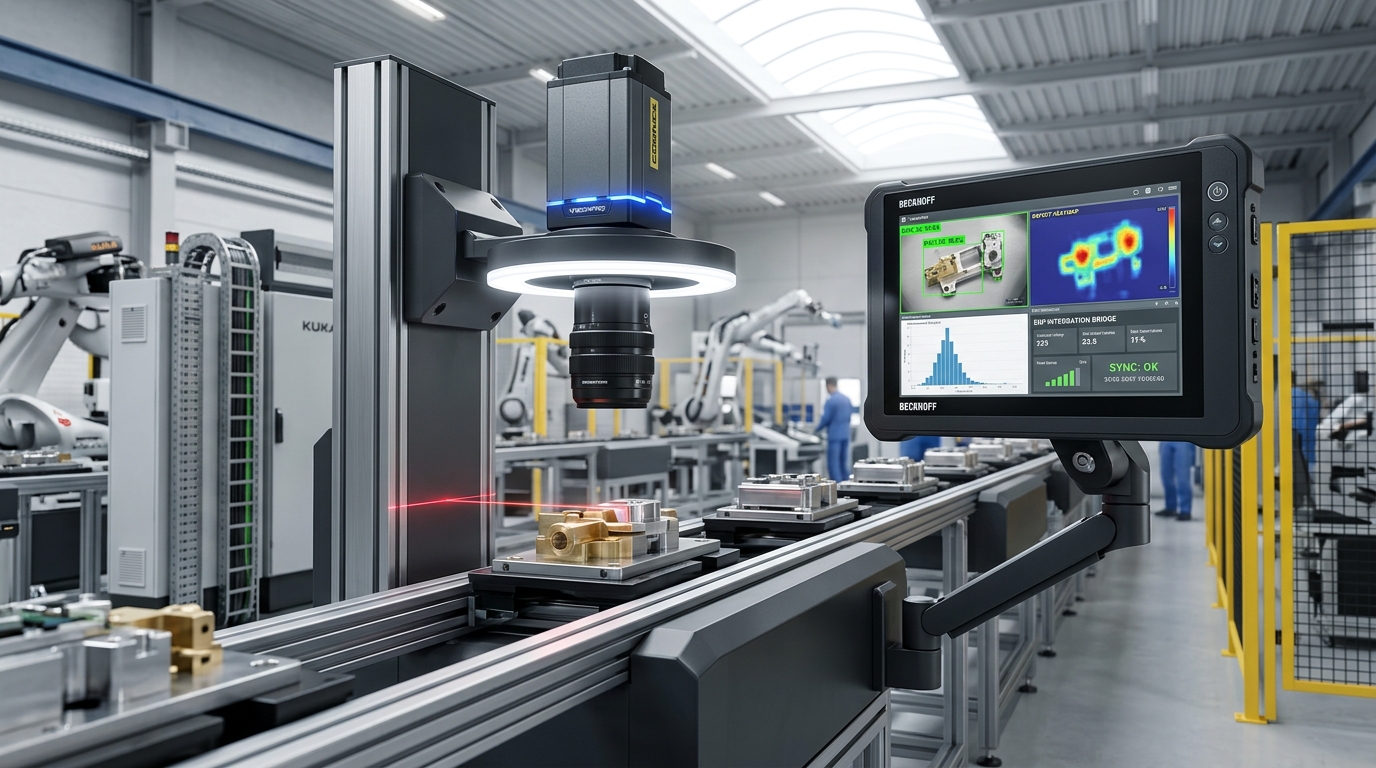
Deploys Telecentric Lenses to eliminate optical perspective distortion entirely, guaranteeing constant magnification regardless of slight vertical object vibrations on the belt. Polarized ring lights and diffuse backlighting isolate stamped metal silhouettes without specular glare.
Unsupervised Anomaly Detection (Zero Defect Data)
Real manufacturing features millions of pristine parts but rare, unpredictable defects (severe data imbalance). We deploy PatchCore and FastFlow unsupervised models trained exclusively on golden reference pieces. When anomalous fractures or tool-marks pass beneath the sensor, the network generates millimetric heatmaps identifying unseen anomalies instantly.
For technical details on deploying production-grade computer vision pipelines, inspect our specialized guide: Computer Vision Quality Inspection in Modern Manufacturing.
Fieldbus Orchestration: Bridging Machine Vision to PLCs and ERP
Upon defect classification, the Edge AI system branches into two concurrent operational streams operating on differing time horizons:
Dual-Path Fieldbus Architecture
Deterministic + AsynchronousVia industrial Digital I/O or Modbus TCP / OPC-UA, the Edge device emits a 24V trigger pulse to the programmable logic controller within 5 milliseconds. The PLC synchronizes belt encoder pulses to trigger pneumatic diverters, ejecting the flawed piece into the scrap chute.
The edge daemon compiles a structured JSON telemetry payload (Work Order ID, Serial Number, Work Center, Defect Class, Confidence Score, Image URI) publishing asynchronously via an MQTT Broker / RabbitMQ to trigger ERP transactional handlers without blocking the optical loop.
The Autonomous ERP Feedback Loop: Scrap Accounting & Quarantine Isolation
When the ERP event ingestion endpoint receives the defect message, it executes three automated workflows with zero human delay:
Automated Quarantine Warehouse Allocation
The ERP initiates an internal stock movement entry, shifting the serial item from "WIP Floor" to "Quarantine Warehouse". This programmatic lock prevents downstream sales, picking, or fulfillment modules from reserving or billing the batch.
Work Order Scrap Ledger Posting
Raw material inputs assigned to the defective part are stripped from finished asset valuation, automatically posting to the **Operational Manufacturing Scrap Expense** account to maintain accurate Standard Costing Variance reporting.
Algorithmic Preventive Maintenance Dispatch
If identical defects repeat three times within 15 minutes (e.g., a recurring 0.3mm borehole deviation), the system concludes tool wear on CNC Station #2, dispatching an urgent maintenance order with pre-reserved spare bits before catastrophic machine failure occurs.
For a deep dive into double-entry accounting mechanics and enterprise inventory structures, explore my companion guide: Deconstructing Enterprise ERP: The Definitive Architectural Manual.
Technical Implementation: Edge Emitter & Django Atomic Webhook
The following battle-tested Python architecture illustrates the dual-engine synergy: the high-speed edge evaluation loop alongside Django's ACID-compliant transactional webhook consumer.
// 1. Edge AI Inference & MQTT Dispatcher (NVIDIA Jetson / Python)
Edge Device / Pythonimport json
import paho.mqtt.client as mqtt
# Configure industrial MQTT broker gateway
mqtt_client = mqtt.Client(client_id="Edge_Vision_Station_04")
mqtt_client.connect("192.168.10.50", 1883, 60)
def evaluate_inspection_frame(frame, work_order_id, part_serial):
"""
Executes real-time defect inference on NVIDIA Jetson using TensorRT.
Emits physical PLC trigger and dispatches asynchronous enterprise ERP payload.
"""
# Run TensorRT FP16 Anomaly Model
is_defective, defect_type, confidence = run_tensorrt_inference(frame)
if is_defective and confidence > 0.88:
# A. Instant physical PLC trigger to divert piece (< 5ms)
trigger_plc_ejector_pulse(line_pin=12)
# B. Construct enterprise telemetry packet
payload = {
"event": "QUALITY_DEFECT_DETECTED",
"work_order_id": work_order_id,
"part_serial": part_serial,
"work_center": "CNC-Milling-02",
"defect_type": defect_type,
"confidence_score": round(confidence, 4),
"action_taken": "PHYSICAL_REJECTED"
}
# Asynchronously dispatch to ERP broker without stalling next frame
mqtt_client.publish(
"factory/line04/quality/defects",
json.dumps(payload),
qos=1
)
return False
return True// 2. Django ERP Atomic Webhook Consumer: Stock Isolation & Maintenance
Django / Backendfrom django.db import transaction
from rest_framework.views import APIView
from rest_framework.response import Response
from cv.models import WorkOrder, StockEntry, MaintenanceTicket, DefectLog
class EdgeQualityWebhookView(APIView):
"""
Ingests Edge AI defect telemetry, executing quarantine transfers and maintenance tickets.
"""
@transaction.atomic
def post(self, request):
data = request.data
work_order = WorkOrder.objects.select_for_update().get(id=data["work_order_id"])
# 1. Persist audit-grade defect telemetry log
defect = DefectLog.objects.create(
work_order=work_order,
part_serial=data["part_serial"],
work_center=data["work_center"],
defect_type=data["defect_type"],
confidence=data["confidence_score"]
)
# 2. Reallocate physical inventory to Quarantine Warehouse
StockEntry.objects.create(
entry_type="Quarantine Transfer",
from_warehouse="WIP-Floor",
to_warehouse="Quarantine-Storage",
part_serial=data["part_serial"],
remarks=f"Edge AI automated rejection: {data['defect_type']}"
)
# 3. Increment Work Order scrap line item
work_order.scrap_count += 1
work_order.save(update_fields=['scrap_count'])
# 4. Check defect repetition threshold for automated maintenance dispatch
recent_defects = DefectLog.objects.filter(
work_center=data["work_center"],
defect_type=data["defect_type"],
created_at__gte=timezone.now() - timedelta(minutes=15)
).count()
if recent_defects >= 3:
MaintenanceTicket.objects.get_or_create(
work_center=data["work_center"],
status="Urgent",
defaults={
"title": f"Preventive Maintenance Alert: 3 Consecutive {data['defect_type']} Defects",
"assigned_team": "Tooling & Mechanical Engineering",
"auto_generated": True
}
)
return Response({"status": "SUCCESS", "message": "Quarantine & Scrap Processed"}, status=200)Capital Feasibility & Return on Investment (ROI) Modeling
Deploying industrial computer vision pipelines represents a strategic capital investment (CapEx) delivering substantial, auditable operating margin enhancements:
| Operational KPI | Manual Quality Assurance | Integrated Edge AI + ERP | Financial Impact |
|---|---|---|---|
| Defect Escape Rate | 12% - 18% of defective parts | < 0.2% (99.8% Accuracy) | Curtails customer return penalties and warranty liabilities by over 90%. |
| Conveyor Inspection Speed | 40 - 60 units / minute | 350 - 600 units / minute | Expands operational line throughput without physical facility expansion. |
| Unplanned Line Downtime | Frequent (Halts only upon catastrophic breakdown) | Near Zero (Predictive tool servicing) | Saves tens of thousands of dollars in lost manufacturing shifts. |
| Investment Payback Period | — | 4 to 8 Months | Exceptional compounding enterprise ROI. |

Ready to Modernize Your Production Inspection with Edge AI?
Computer Vision Architecture & Industrial Digital Transformation with Ahmed Al-Gendy
Unifying high-speed machine vision hardware with complex enterprise ERP databases requires specialized cross-disciplinary expertise—synthesizing low-level computer vision algorithms, industrial fieldbus protocols, and resilient backend systems. With ongoing postgraduate research in Artificial Intelligence (AASTMT) and Business Administration (MBA - AAMBFS) alongside 13+ years of engineering leadership, I partner with industrial leaders to engineer high-throughput, closed-loop inspection pipelines.