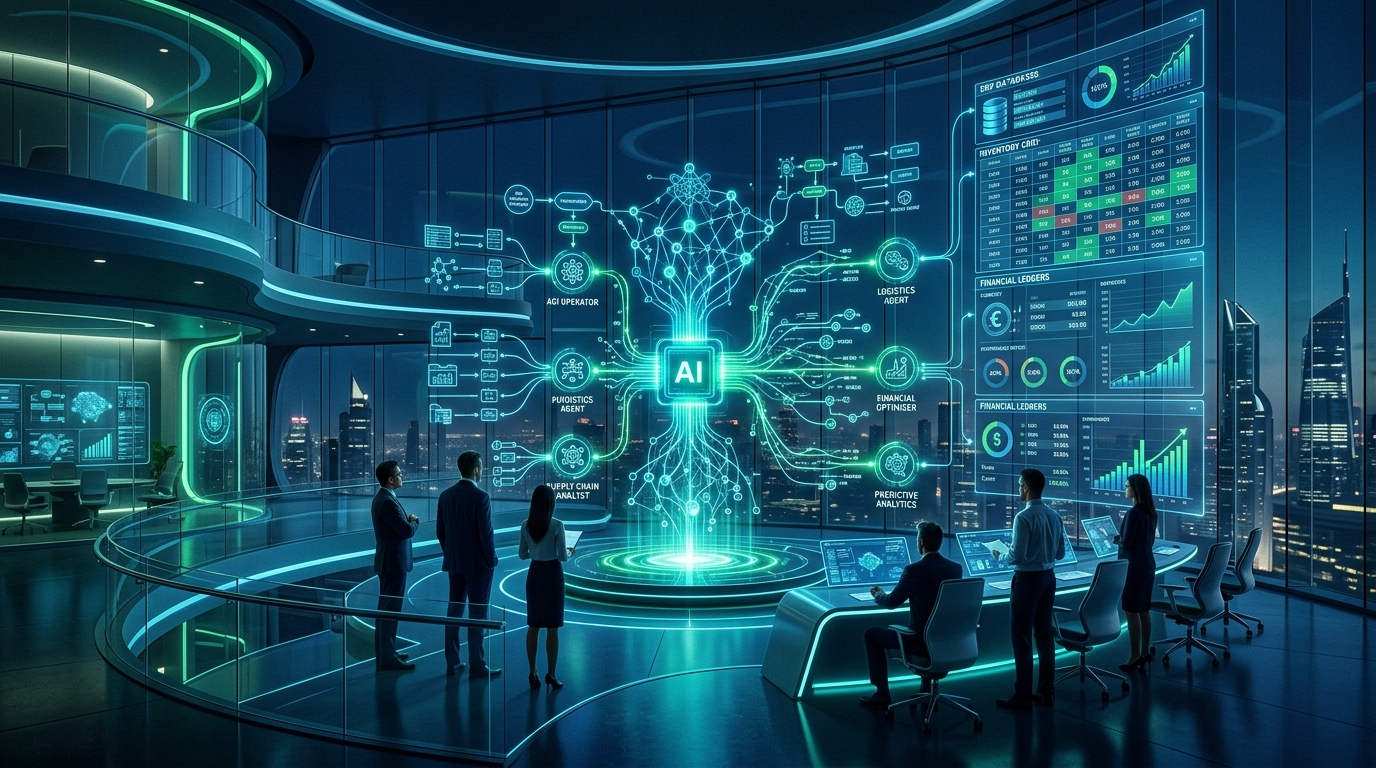
The era of basic conversational chatbots is over. In 2026, enterprises are transitioning from passive generative text interfaces to Autonomous Agentic AI: goal-oriented digital workers equipped with tool-calling capabilities, persistent memory, and authenticated credentials to query live ERP databases, reconcile financial ledgers, and trigger supply-chain orders with surgical precision.
1 The Fundamental Divide: Passive LLM vs Autonomous Agent
The critical difference lies in action execution and tool invocation. While a standard language model generates probabilistic text responses, an autonomous agent executes deterministic workflows across enterprise business software.
Reacts to prompts ➔ generates language strings ➔ lacks access to live inventory databases, possesses no multi-step memory, and cannot execute state-changing actions.
Receives high-level objective ("Identify low-stock items and draft supplier POs for lowest bid") ➔ plans sub-tasks ➔ queries ERP via APIs ➔ prepares purchase orders for executive review.
2 Engineering the Core Architecture: Multi-Tier Integration
Engineering robust enterprise AI agents requires a 4-pillar architectural foundation:
1. Tool-Calling & Model Context Protocol (MCP):
Standardizing JSON function definitions so the agent can invoke strictly typed backend APIs such as fetch_inventory_levels() or calculate_customer_lifetime_value().
2. Role-Based Access Control & Human-in-the-Loop:
Treating agents as privileged identities with strict RBAC boundary policies. High-risk actions (financial transactions or record deletions) mandatorily trigger Human-in-the-Loop (HITL) authorization.
3. Deterministic Event Sourcing & Audit Logging:
Every thought chain, query parameter, and state transition is captured in an append-only audit trail for compliance verification and operational observability.
The costliest trap organizations fall into is deploying proprietary agent frameworks on top of fragmented, unnormalized legacy data schemas.
An AI agent is only as reliable as the underlying database hygiene and API contracts. My recommended 3-step engineering roadmap is:
- Normalize and sanitize your core relational schemas (PostgreSQL / Django ORM) before introducing agentic layers.
- Leverage local self-hosted open-weights models (such as Qwen 2.5 and DeepSeek) for routine structured tasks to slash API costs by up to 80%.
- Architect domain-bounded micro-agents (e.g., dedicated Procurement Agent, Customer CRM Agent) rather than monolithic fragile systems.
Ready to Architect Your Enterprise Agentic Strategy?
Organizations that institutionalize agentic workflows today build insurmountable advantages in operational speed and operational margin expansion.
If your enterprise is preparing to deploy autonomous agents or modernize legacy ERP/CRM architectures, I offer specialized strategic consulting and hands-on system engineering.